
Joseph Magee, PhD
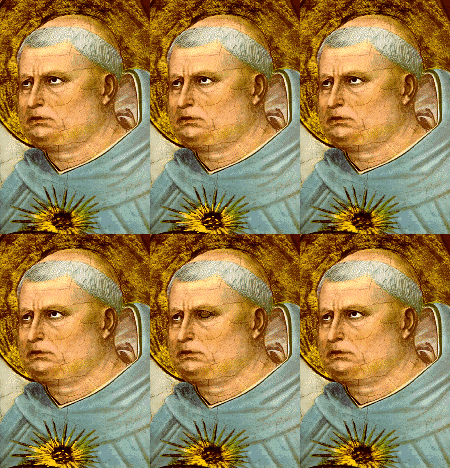
Since 1996, I have written, produced, and maintained the Thomistic Philosophy Page. I earned my PhD from the Center for Thomistic Studies at the University of Saint Thomas, Houston, Texas, in 1999 and for two years I taught philosophy full-time at UST. From 2002 – 2021, I was campus minister at Sam Houston State University, where I regularly taught philosophy of religion. I also taught part-time at UST, Montgomery College, University of Houston – Downtown, and Houston Community College.

Drawing on over twenty-five years of teaching, as well as writing and managing the Thomistic Philosophy Page, Dr. Joseph Magee provides a thorough and engaging outline of the fundamentals of the philosophical though of Saint Thomas Aquinas. Although the Angelic Doctor was a professional theologian, he incorporated a great deal of philosophy in his theological reflections, especially (though not exclusively) that of Aristotle, as well as innovating his own insights into the rational structure of reality, the human soul and moral reasoning. To Know the Truth of Things: An Overview of Thomistic Philosophy leads the student of Aquinas’ philosophy through the elements that make it up and points to the contributions his philosophical insights make to an integrated human understanding of Sacred Doctrine, the knowledge proper to God and the Blessed.
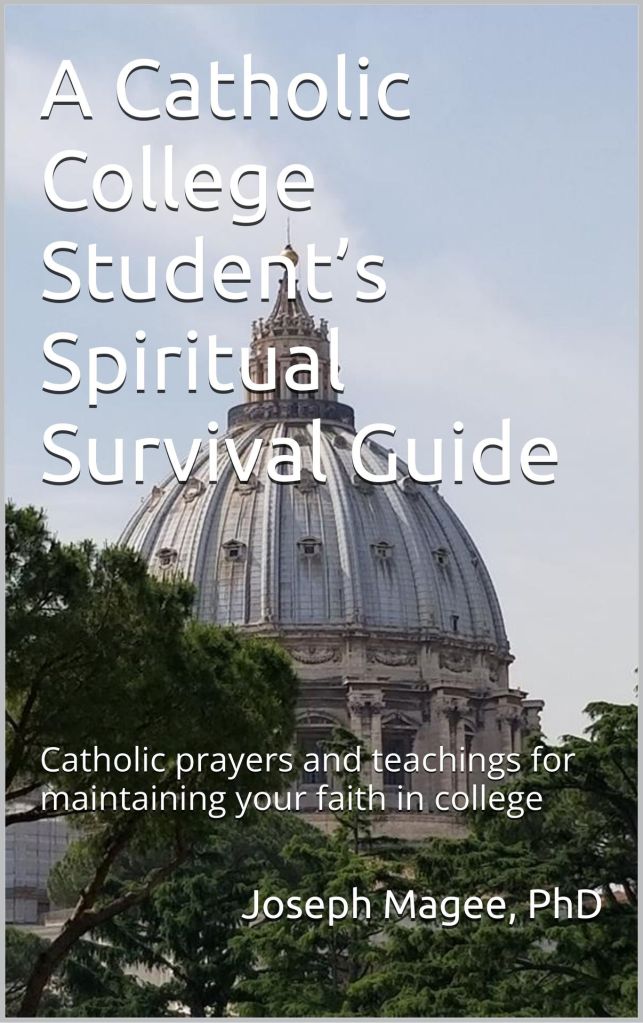
In order for students to make the most of their time in college, and to have the resources they need to flourish spiritually and to maintain and share their Catholic faith, I wrote A Catholic College Student’s Spiritual Survival Guide to provide some basic Catholic prayers, practices, and teaching to get them started or to keep them going in cultivating and developing their relationship with Jesus in and through the Church He established for the salvation of the world. Download a PDF version for free!
My first book, Unmixing the Intellect: Aristotle on Cognitive Powers and Bodily Organs was published by Greenwood Press in 2003. In this work, I argue that, according to the principles he develops throughout the De Anima, Aristotle successfully argues for a strong sense of the separateness of mind (nous) insofar as its activity occurs apart from the body. Because of the contrast he draws between mind and the senses in his arguments, I examine closely Aristotle’s understanding of sensation and the sense powers. In the course of this analysis, I argue against various interpreters who claim that his theory of mind is cognitivist, functionalist or endorses some version of supervenience.
Other Publications:
How Scientism Undermines Science. Magis Center for Reason and Faith. October 10, 2023.
The Focus on Immanent Activity in the Second Way, Thomistica.net. July 7, 2021.
The Alleged Birthday Fallacy in Aquinas’s Third Way Published in Reflections on Medieval and Renaissance Thought, edited by Darci Hill. Cambridge Scholars Publishing, 2017: 166-174.
Sense Organs and the Activity of Sensation in Aristotle, Phronesis 45 (2000): 306-330.
Law and Virtue in Aquinas, Published in Jaarboeke 1996, edited by Henk J.M. Schoot. Thomas Instituut te Utrecht, Netherlands, 1997: 37-54.
Select Presentations:
“Aristotle and Contemporary Philosophies of Mind.” Paper delivered at the Dominican School of Philosophy and Theology, Berkeley, California, February 6, 2008.
“Aristotle and Aquinas on Proving the Intellect’s Immateriality,” Paper delivered at The International Étienne Gilson Society meeting, Berkeley, California, October 22, 1999.
“Receptivity of Nous in De Anima, III.4,” Paper delivered at the Society for Ancient Greek Philosophy session at the Pacific Division Meeting of the American Philosophical Association, Los Angeles, California, March 26, 1998.
If you have a question about St. Thomas Aquinas, philosophy or life in general, or to leave a comment, please contact me through the form below.
Thanks for visiting!


Updated March 4, 2025
 Thomistic Philosophy Page