
Diplomats and Heretics
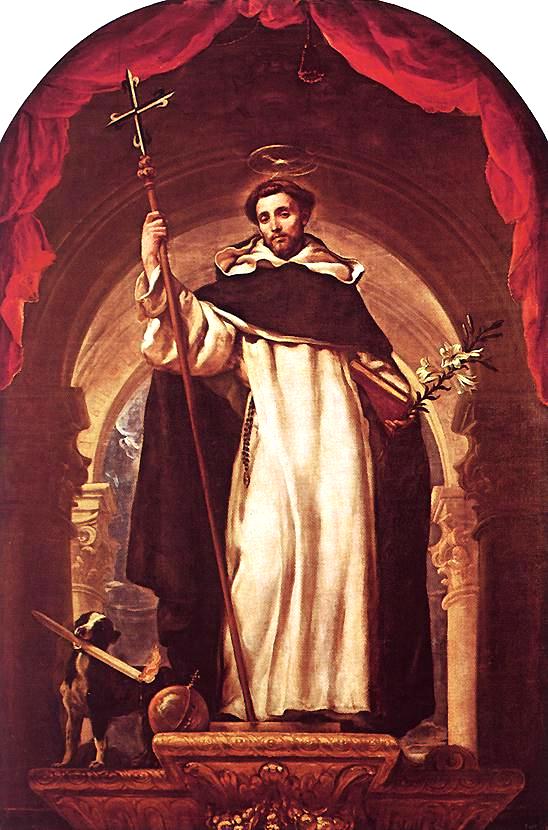
The Dominican Order, i.e., the Order of Friars Preachers, was founded by St. Dominic de Guzman (c.1170-1221), a canon or secular (i.e., diocesan) priest of the Cathedral of Osma in Spain, and he came to establish this order when he and his Bishop, Diego, were on a diplomatic mission for the King of Castile. Passing through the south of France in 1206, the two royal legates witnessed first-hand to what a great extent the lay people of the area had abandoned the Christian faith to follow dualistic and heretical beliefs.
The laity in this area of France at the time received little instruction in the Catholic faith from the clergy, and they had become disaffected by the official Church which was seen as corrupt and part of the ruling establishment. They were, however, eager to follow the Gospel, and so there arose in the 12th century, more or less spontaneously, poor itinerant preachers who claimed to imitate the poverty of Jesus and proclaim his message (called Albigensians because they were centered in the town of Albi).
Toward the end of the twelfth century and during the early part of the thirteenth, the Albigensians grew in number because of the zeal, evangelical poverty, and intellectual acumen of the leaders, the “Cathari.”
James A. Weisheipl, Friar Thomas D’Aquino: His Life, Thought, and Work (Doubleday and Co. 1974), p. 21.
Despite initially being generally faithful to the Church, they were looked upon with suspicion by ecclesial authorities. These preachers, often acting without the permission of, and even against, the directives of such authorities, began to drift away from the Christian truth. These preachers and their followers whom Dominic and Diego encountered, for instance, taught that everything good is from God who is Spirit and Goodness, and that whatever is opposed to such goodness (such as the Church authorities who opposed their preaching) must arise from a power opposed to God. They believed that matter, too, being opposed to Spirit, is evil and must be from the source of evil, i.e., from the Devil, equal in power to God. Likewise, the Catholic Sacraments, since they make use of material things like water, wine, bread, and oil, could not be from God. They also viewed the human body as either worthless, or as evil and a prison for the immortal soul. The sincerity of these austere, but misguided, preachers was turned to political ends by local secular authorities, who, in order to thwart their ecclesiastical rivals, gave support to these heretics.
Poverty and Preaching
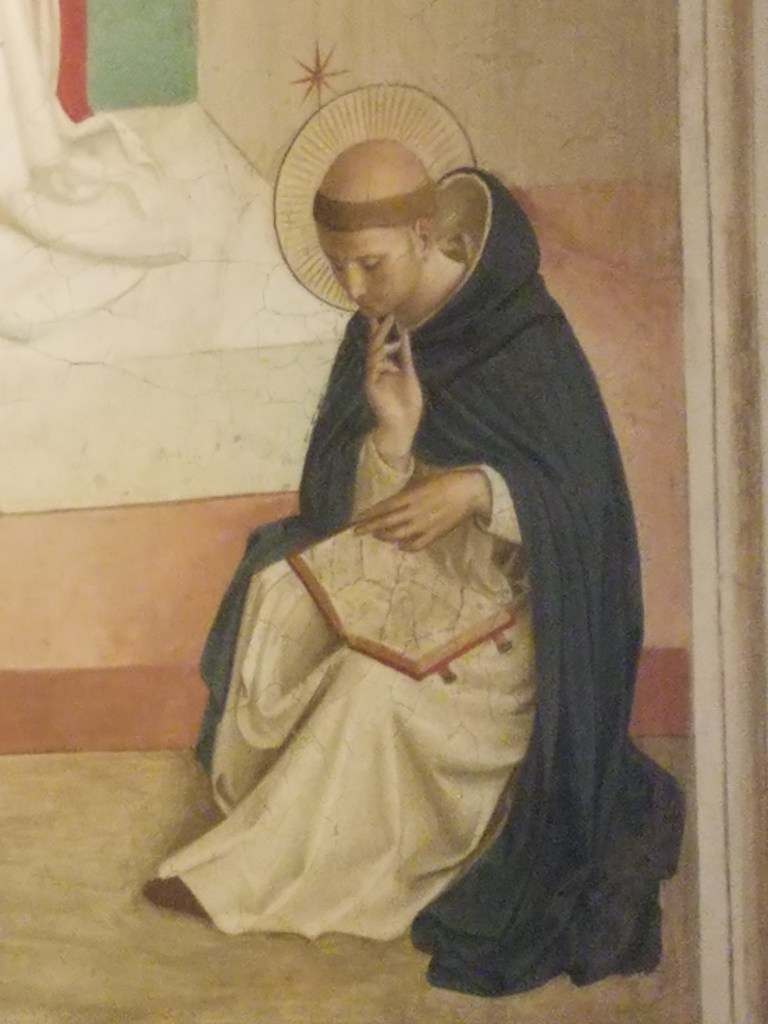
Dominic and Diego also encountered Cistercian monks whom the pope had sent as missionaries to convert the heretics back to the Catholic faith.
Numerous delegations of Cistercians and papal legates had been sent into the territory to convert the Albigensians; but these efforts met with little success. Bishop Diego and Dominic both soon realized that the heretics could be won over only by the practice of evangelical poverty, deep learning, and zeal for souls.
Ibid.
Sending home the rest of their retinue, Bishop Diego and St. Dominic adopted extreme austerity and began preaching the truth that all things, even material things, are good and are created by the only source of creation, God. (One finds this traditional Dominican opposition to Albigensian dualism in Thomas’s teaching on God as sole source of creation (On the Power of God, q. 3, a. 5) and in his use of Aristotle’s views on body and soul.) Their approach was more successful than the Cistercians had been, and so they totally committed themselves to the task of converting the heretics. Although Bishop Diego died in 1207, Dominic and the rest of the missionaries continued their preaching in the south of France working to restore the faithful of that region to orthodox Catholic faith.
Dominicans and Universities
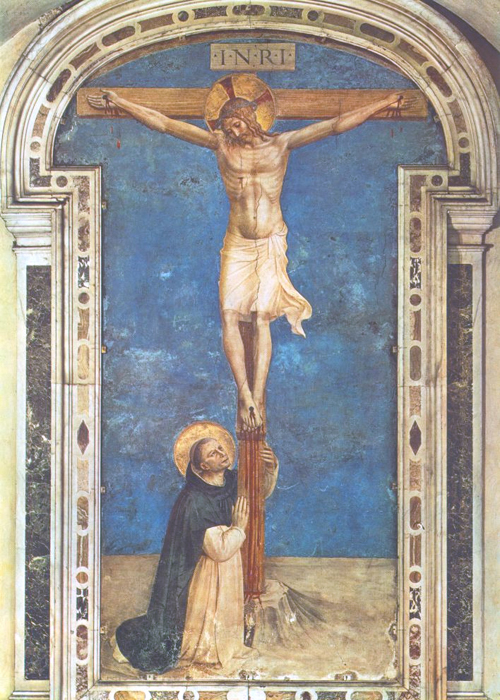
Dominic continued to preach the Christian Gospel despite the fact that civil war broke out in the region. Under pressure from Pope Innocent III, the King of France sent a crusade against the Albigensians who, with the support of the Count of Toulouse, had murdered the papal legate. From 1206 until 1215, Dominic toiled in the south of France in relative obscurity, attracting followers to assist him in his preaching task. In 1216, Dominic received official recognition from the pope, Honorius III, for his community as the Order of Friars Preachers. No sooner had he established an institutional base, however, than St. Dominic sent his brothers in small groups to various centers of learning throughout Europe, even to the medieval world’s preeminent educational center, the University of Paris. Dominic believed that sound preaching must arise out of a firm foundation in theology, and so he sent his brothers to be educated in Christian doctrine and to recruit others so educated. Quickly, the Order of Preachers spread throughout Europe, becoming well established in every institution of higher education.

Saint Dominic was a man who drew his strength and his wisdom from a profound prayer life; he was said to have always been either talking to God or talking about God. Likewise, he sought to impress upon the Friars of his Order that their preaching should begin in the quiet solitude of prayer and study. Thus, a motto of the Order of Preachers is “Give to others the fruits of your contemplation.” This spirit of contemplation and preaching, humility, poverty and service embodied by Holy Father Dominic formed the character and found expression in one of his greatest sons, Saint Thomas Aquinas.
Learn more about St. Dominic and the Dominican Order by following the links below:

- St. Dominic de Guzman from the Dominican Friars: the Order of Friars Preachers
- Province of the Holy Name of Jesus – Western US
- Province of St. Martin de Porres – Southern US
- Province of St. Joseph – Eastern US
- Province of St. Albert the Great – Central US
- St. Dominic – from the Catholic Encyclopedia Online.
 Thomistic Philosophy Page