
To Know the Truth of Things: An Overview of the Philosophy of Saint Thomas Aquinas (Forthcoming)
The study of philosophy aims not at knowing what men have thought, but what the truth of things is. — Saint Thomas Aquinas, Commentary on Aristotle’s On the Heavens, Book I, Lecture 22, no. 228..
Drawing on over twenty-five years of teaching, as well as writing and managing the Thomistic Philosophy website, Dr. Joseph Magee provides a thorough and engaging outline of the fundamentals of the philosophical thought of Saint Thomas Aquinas. Although the Angelic Doctor was a professional theologian, he incorporated in his theological reflections a great deal of philosophy especially (though not exclusively) that of Aristotle, as well as innovating his own insights into the rational structure of reality, the human soul, and moral reasoning. To Know the Truth of Things: An Overview of the Philosophy of Saint Thomas Aquinas leads the student of Thomistic philosophy through its historical context, principles, and principal elements to present a more complete picture of his philosophical insights and the contribution they make to an integrated understanding of reality, which as he writes, is the goal of philosophy: to know the truth of things.
Table of Contents
- Introduction to the Life and Work of Saint Thomas Aquinas (Sample Draft)
- Basics of Logic: the Art and Science of Reasoning
- Philosophy of Nature: the Study of What Is in Matter and Motion
- Philosophical Psychology: the Study of the Soul
- Metaphysics: the Study of Being as Being
- Natural Theology I: Knowing God’s Existence through Reason
- Natural Theology II: Knowing (Something of) God’s Nature (Attributes)
- Ethics: the Study of Good and Evil Human Acts and Virtues
- Political Thought: the Study of the Common Good
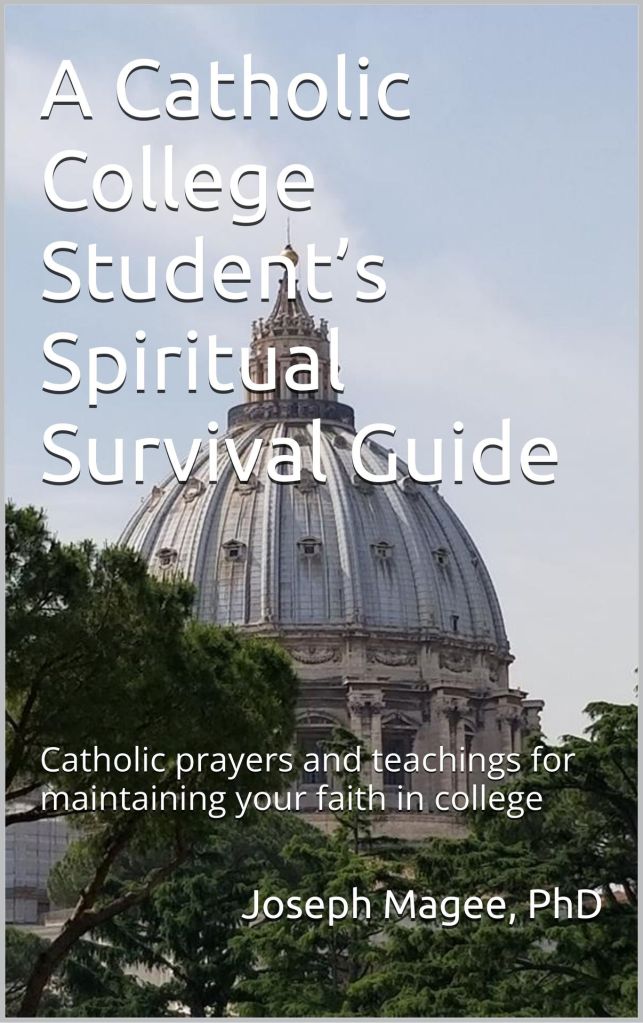
A College Student’s Spiritual Survival Guide, 2nd Revised Edition (2024)
College is an exciting time, filled with many challenges: academic, personal, emotional, and spiritual. The Catholic Church believes that following Jesus Christ is the most important thing you can do with your life at any time, but especially in college. Remaining close to Christ and His Church can help you navigate some of life’s challenges, give you direction as you seek your calling in life, and provide peace and joy in the midst of life’s difficulties.
In order for you to make the most of your time in college, and so you have the resources you need to flourish spiritually and to maintain and share your Catholic faith, this little book provides some basic Catholic prayers, practices, and teaching to get you started or to keep you going in cultivating and developing your relationship with Jesus in and through the Church He established for the salvation of the world. Download E-book free!
Table of Contents
INTRODUCTION — 1
PART I — PRAYER
- WHAT IS PRAYER? 2
- PRAYING THE SCRIPTURES 4
- DAILY PRAYERS 5
Sign of the Cross
Our Father
Hail Mary
Glory Be
Apostle’s Creed
Hail Holy Queen
How to Pray the Rosary
Memorare
Act of Faith
Act of Hope
Act of Love
Act of Contrition (Sorrow)
Prayer to the Holy Spirit
Morning Offering
Night Prayer - PRAYERS FOR SPECIAL NEEDS 14
Prayer before Study of St. Thomas Aquinas
Prayer to St. Joseph of Cupertino for Students
Prayer of Thomas Merton
Cardinal Henry Newman Meditation
Jeremiah 29:11-14
Isaiah 43:1-3
Prayer for Vocations
Prayer for Purity of St. Thomas Aquinas
Prayer for the Addicted
Prayer in Time of Distress
Prayer for Perseverance - PRAYERS OF THE SAINTS 20
Prayer to St. Joseph
Prayer to St. Michael
Breastplate of St. Patrick
Peace Prayer of St. Francis
Canticle of Brother Sun of St. Francis
PART II — THE CATHOLIC FAITH
- INTRODUCTION 23
- ARE CATHOLICS SAVED? 25
Jesus Christ: Savior and Redeemer
The Necessity of Faith
What Exactly Is Salvation?
Why Jesus Died on the Cross
Salvation and Human Freedom
Good Works Done in Faith - CATHOLICS AND THE BIBLE 38
The Bible is the Inspired Word of God.
Sola Scriptura – Is the Bible Alone the sole and complete source for the Christian faith?
Apostolic Tradition is the source of Scripture
Sacred Scripture and Tradition in the Church
Teaching Authority of the Church determined which books belong in the Bible
Why Catholic Bibles have more books than Protestant ones
Tradition interprets Scripture - SACRAMENTS 49
Baptism
Original Sin
Infant Baptism
Eucharist
Confirmation
Confession or Reconciliation
Anointing of the Sick
Marriage
Sex and Birth Control
Holy Orders
Celibacy of Priests
Addressing Priests as ‘Father’ - PURGATORY 72
- THE POPE: SIGN AND PRINCIPLE OF UNITY 80
- MARY, THE MOTHER OF GOD 82
- PRAYERS OF THE SAINTS 83
Unmixing the Intellect: Aristotle on Cognitive Powers and Bodily Organs (Greenwood 2003) (purchase on Amazon)
In this work, Dr. Magee argues that, according to the principles he develops throughout the De Anima, Aristotle successfully concludes to a strong sense of the separateness of mind (nous) insofar as its activity occurs apart from the body. Because of the contrast Aristotle draws between mind and the senses in his arguments, Dr. Magee examines closely his understanding of sensation and the sense powers. In the course of this analysis, Dr. Magee argues against various interpreters who claim that Aristotle’s theory of mind is an ancient iteration of cognitivism, functionalism or some version of supervenience.
Unmixing the Intellect: Aristotle on Cognitive Powers and Bodily Organs (complete)
Table of Contents
Preface — ix
Introduction — xi
Abbreviations for Works of Aristotle — xix
- Aristotle and Contemporary Theories of Mind — 1
- The Separability of Nous and Cognitivist Functionalism — 25
- The Similarities between Nous and Sense — 53
- The Relationship of Sense Powers to Their Organs — 75
- The Difference between Aisthesis and Nous (sample) — 117
Bibliography — 145
Index — 153
 Thomistic Philosophy Page