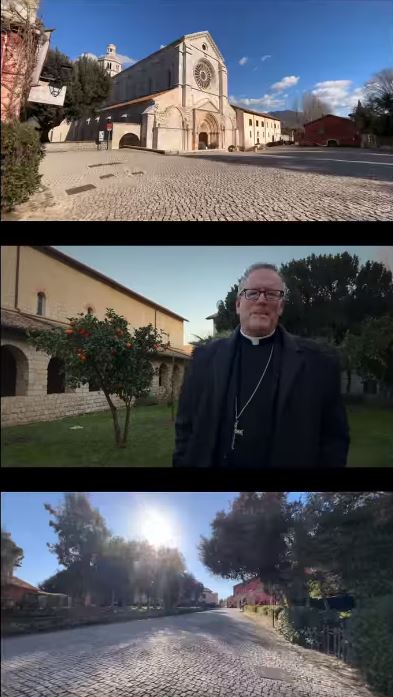
In March I posted about surprising ways various groups were commemorating the 750th anniversary of the death of Saint Thomas Aquinas including a workshop organized by the Pontifical Academy of Social Sciences on “Aquinas’ social ontology and natural law in perspective“. At the time, I noted that Bishop Robert Barron also posted a video about his participation in this workshop where he delivered a talk, intriguingly titled “Ipsum Esse in Relation to Catholic Social Thought.” Well, a couple of days ago on his Word On Fire Show podcast/YouTube series, he discussed that paper, among other things.
His video goes over the importance of Saint Thomas’s thought and work and the influence it had on Barron becoming a priest and professor of philosophy and theology. It also gives a good, quick overview of Thomistic metaphysics and the real distinction between essence and existence or “act of to be” (esse in Latin), and is worth a watch or listen in order to reflect (again) on the fundamental existential composition running through created being. Barron goes on to recount how this insight into reality leads Aquinas to understand God as Creator as the ultimate source of this composition in every finite, limited being, and so as Himself uncomposed, i.e., simple, and so unlimited Act of To Be Himself, in Latin Ipsum Esse Subistens.

You can read St. Thomas’s own exposition in a short early work of his, On Being and Essence (De Ente et Essentia in Latin), especially chapter 4. This contains the famous man/phoenix argument: one can know what a man or phoenix is (essence) without knowing whether either of them really exists (has “to be” (esse), i.e. existence); therefore essence is distinct from esse. Thus, Barron provides an accessible, pithy recapitulation of Thomistic metaphysics.
I was disappointed, however, that Barron didn’t explore more fully the connection that this conception of God has to do with how we define the authentic human good and the authentic social good, the aim of Catholic Social Teaching, which I thought was the main point of the paper he gave in Rome in March and the subject of the discussion in the video. While it is true, as he says, that these goods ultimately consists of a surrender to God as the Supreme Good (or rather Transcendent Good — consult the video for this distinction) at the summit of the hierarchy of goods, more can be said than (ala von Hildebrand) that “you just see certain values, and at the summit of that hierarchy is God, the Summum Bonum, so a life that’s lived ordered to God” is the ultimate moral and political good.

The more that can be said is St. Thomas’s remarkably robust and nuanced teaching about Natural Law, wherein the good of a creature, including a human being, is living according to its nature by which it participates and receives its own act of existing (esse) from God Who Is His Own Being (Ipsum Esse Substens). Indeed, natural law as foundational to Catholic social teaching was the focus of the whole workshop, so it is especially curious Barron does not mention natural law in his video discussing the paper he delivered there.
According to St. Thomas’s conception of Natural Law, the human good, individually and societally, is for each person to fulfill his or her human nature and so to fully exist as God created him or her according to our common essence as rational and free, and thus to develop intellectual and moral virtues according to each person’s unique circumstances. It would have been interesting to see how Barron traces the connection between God understood metaphysically as the Act of Being Itself and ethical and political goods as the fulfillment of human nature in the pursuit of natural ends. I think that Barron had a particular interest in safeguarding theological and religious considerations of God as relevant to ethical and political discussions, and so he mentions very briefly “surrender to God” as a “life lived ordered to God” as ordering principles for the distinctly human good, but I fear such theistic considerations obscure and undermine a key part of Thomistic natural law, vis., that it is known by all people at all times and places and that it cannot be blotted out of the human heart. More on this at the end of this post.
I’m not sure how Barron argued his point in his paper at the conference, but Aquinas has a lot to say about the nature of goodness in terms of things’ existence as determined by or corresponding to their essence or nature, and God’s causing of creatures by giving existence according to their nature. This, then, would seem to be the apparent way to make the connection between Thomistic metaphysics and Thomistic natural law. For instance, when discussing the nature of evil, Saint Thomas says,
Existing itself chiefly has the nature of being desirable, and so we perceive that everything by nature desires to conserve its existing and avoids things destructive of its existing and resists them as far as possible. Therefore, existing itself, insofar as it is desirable, is good. . .. Therefore, evil, which is universally contrary to good, is necessarily also contrary to existing.
Quaestiones Disputatae De Malo 1,1
Here, Aquinas, quite sensibly, claims that evil opposes what is good, and again, quite sensibly understands that what is good is desirable. His insight though is to note that what is most or fundamentally desirable is a thing’s existing – its own being.
Aquinas, furthermore, sometimes calls the goods that a thing is supposed to have ‘perfections.’
Now it is clear that a thing is desirable only in so far as it is perfect; for all things desire their own perfection. But everything is perfect so far as it is actual. Therefore it is clear that a thing is perfect so far as it exists.
Summa Theologiae Ia, q. 5, a. 1
He doesn’t mean that a thing with some perfection is perfect as God is supposed to be perfect. He is using ‘perfect’ in a more limited way, meaning fulfilled or complete. He is saying a thing is good to the extent that it exists as completely as it should, and it desires its own being and the completeness of being the kind of thing it is.
Every creature exists as belonging to certain classes or categories of things, for the goodness or perfection that a thing is supposed to have is determined by the kind of thing it is. This is the thing’s nature, the internal principle whereby it is what it is, and does what is characteristic of things of that sort. Dogs, humans, and other animals each have their own objective nature that is supposed to see, i.e., be aware of their surroundings by perceiving visually light, color, and shape. Animals, in general, by nature are able to see; this truth underlies the fact that when they do not see, they have suffered a natural or physical evil.
Aquinas explains that the objective nature of a thing specifies its various perfections, goods which do (or should) belong to it, for it to be complete in its being.
Everything is said to be good so far as it is perfect; for in that way only is it desirable (as shown above (articles 1,3). Now a thing is said to be perfect if it lacks nothing according to the mode of its perfection. But since everything is what it is by its form (and since the form presupposes certain things, and from the form certain things necessarily follow), in order for a thing to be perfect and good it must have a form, together with all that precedes and follows upon that form. . . . But the form itself is signified by the species; for everything is placed in its species by its form. . . . Further, upon the form follows an inclination to the end, or to an action, or something of the sort; for everything, in so far as it is in act, acts and tends towards that which is in accordance with its form.
Summa Theologiae Ia, q. 5, a. 5
“Form” here stands for essence or nature, as for that matter, so does “species.”
Goodness, for Aquinas, is a transcendental quality, which means that it is found in all the categories of being. Moreover, goodness is convertible with being, which means that a thing’s goodness is its being as that is the object of an inclination, either of itself or of another thing. Thus, Aquinas explains what was a well established dictum in the Middle Ages: “the good is what everything desires.” What everything, every being, desires, i.e. inclines toward, is that it continues to be or exist. This is the most universal sense of goodness, and the sense in which everything is good, insofar as everything is a being. This, then, is a sort of general metaphysical goodness. But Aquinas says that this is goodness only in a certain respect (secundum quid). The absolute goodness of a thing (secundum se) is what is proper to it, and so if something is lacking some good which is proper to it, it has an evil since evil is simply the lack of a good that is due to it. The absolute goodness of a thing is its perfection, i.e. it having all the being it is supposed to have.
St. Thomas carries this metaphysical insight into good and evil even into the moral sphere. For Aquinas, an action is morally good only insofar as it tends toward the good that is appropriate to human nature as determined by reason, such that moral evil too, (wrongdoing, crime, – in a word – sin), just as ‘physical,’ or natural (non-moral) evil is a privation, or lack of a due good.
We must therefore say that every action has goodness, in so far as it has being; whereas it is lacking in goodness, in so far as it is lacking in something that is due to its fullness of being; and thus it is said to be evil: for instance if it lacks the quantity determined by reason, or its due place, or something of the kind.
ST I-II.18.1
When considering the specifically human good, moral or political, for Aquinas, it is what reason discovers that one ought to do, what fulfills one’s nature, and so perfect’s one’s being, act of existing. Thus, morality is founded in his notion of natural law. This being so, if a human act (one done deliberately and freely) is directed by reason, it has everything it is supposed to have. To be directed by reason means that that act has as its object the true good as reason discovers what that is. Good, in this sense, as the object of the will is also fundamentally absolute metaphysical goodness. Thus an act which tends toward a true good as discovered by reason is a good act. An act to preserve the being of another person which is decided upon as the result of rational deliberation would be an example of a morally good act. Thus, it is not enough that an act tend toward a good end, but in order to be a good human act, it has to involve right reason and employ means which reason determines to be appropriate and thus, also good.
Aquinas distinguishes different levels of precepts or commands that constitute or comprise the natural law. The most universal is the command “Good is to be done and pursued and evil avoided” (ST I-II, 94, 2). This applies to everything and everyone, so much so that some consider it to be more of a description or definition of what we mean by “good.” For these philosophers, a thing is “good” just in case it is pursued or done by someone. Aquinas would agree with this to a certain extent; but he would say that that is a definition of an apparent good. Thus, this position of Aquinas has a certain phenomenological appeal: a person does anything and everything he or she does only because that thing at least “appears” to be good. Even when I choose something that I know is bad for myself, I nevertheless chooses it under some aspect of good, i.e., as some kind of good. I know the cake is fattening, for example, and I don’t choose to eat it as fattening. I do, however, choose to eat it as tasty (which is an apparent, though not a true, good). A true good is an object of desire which reason determines to be appropriate or fitting to a given person, in certain circumstances, in light of their universal human nature (ST I-II, 94, 3, esp. ad 3). Sometimes this will include eating cake, but not too much of it.
So God in being the Subsistent Act of Existence (To Be) is also the source of goodness and the fact that a creature is ordered to its own natural good precisely by God being the source of esse, the act of to be, of creatures according to their specific essence or nature. This nature or essence is the form or pattern according to which God gives them to share in His being.
Aquinas, thus, develops a remarkably robust and nuanced notion of natural law, considering it is laid out in only four questions in the Summa Theologiae (I-II, 90-94). It is also remarkable that this cornerstone of his ethical, social, and political thought coheres so well and tightly with his core metaphysical insights. These facts about these remarkable features of Thomistic philosophy, though, would seem to be of interest only to Thomists, or perhaps scholars of medieval philosophy. It is not immediately apparent how the connection between these two insights of Saint Thomas advance or make practical the application of natural law to moral, social, legal, or political issues. It is again disappointing that Bishop Barron gave no indication in his video if these insights have a practical payoff, and what it might be.
I said above that Barron might have been seeking to safeguard theistic religious concerns as relevant to moral, social, and political discussion given other things he has said or written. It is a recurring theme of his that Christians need not and should not leave their religious convictions out of their social and political engagement, so he might be trying to highlight how God metaphysically is the source of natural law in being the source of nature (human and otherwise) precisely in Thomistic terms of essence and existence. Perhaps, this is his goal: to get Catholics and other Christians to see that social and political engagement in discussions about the nature of the authentic human good are inherently, or at least ultimately, theological. Or even that those who defend human dignity and inherent human rights (as identified by natural law) for religious reasons, are within their natural and Constitutional rights to do so. (Ironically, those who are now at work to uphold the inherent human dignity at the heart of Catholic social teaching (Annunciation House in El Paso, Texas) for religious reasons are having their Constitutional protections challenged by a supposed champion of natural law morality (Republican Texas Attorney General, Ken Paxton).)
But I am afraid that this focus on its theistic (metaphysical) foundation obscures an essential part of Thomistic natural law, namely that one need not see God as its author to see that human nature is the source of natural rights and responsibilities. Even an atheist can and should see that ethical and political goods are determined and defined by what we naturally desire and seek, and so we owe to one another as inherent human rights to pursue these goods. At one point, Barron says that the authentic social and political good is theocratic only to the extent that one should acknowledge “the Laws of Nature and of Nature’s God,” as the Declaration of Independence (deistically) puts it. I am sorry to say that even so little theocracy has proven to be far too much for secular defenders of modern liberal democratic values. But again, insisting on God as the ultimate foundation, especially the metaphysical foundation, of Thomistic Natural Law, is unnecessary. Perhaps the theological basis of natural law can be appealing to the theist who already sees the divine authorship of nature, but to the atheist, God can be safely ignored since the “Laws of Nature” still define fundamental human rights he seeks to defend and uphold.
 Thomistic Philosophy Page