I passed by a church recently which had the following message on its marquee sign:

Be an organ donor.
Give your heart to Jesus!
Initially, I thought, “Oh, that’s clever and cute. It fits with the whole ‘Jesus is my personal Lord and Savior’ deal” of a lot of Protestant denominations. With their focus on faith alone, I get why they want to encourage people to give themselves ‘whole-heartedly’ to Jesus.
But because I think about theological themes way too much, I thought that this church sign writer got our relationship to Jesus backwards. It’s not that Jesus stands in need of the donation of my heart, but that I need His. And with today’s Feast of Corpus Christi (Solemnity of the Body and Blood of Christ), and the fact the Catholic Church in the US is getting ready for its first National Eucharistic Congress in 83 years, I thought organ donation was an apt metaphor to reflect upon for the Most Holy Eucharist.

In literal (living) organ donation, someone who has lost the functional ability of an organ receives a new one (or part of one) from someone who can spare it: a kidney, or a part of the liver, lung, pancreas, or intestines. (Of course, many, perhaps most, organ transplants (especially heart transplants) do not come from living donors, so the parallel to Jesus is not perfect – though he did die to make his living donation possible.)
The main point of the spiritual comparison, though, is that my ‘heart’ became unable to do what it was made for, i.e., love, because of sin, and so I am in need of a new one. Indeed, the Prophet Ezekiel foretold the dysfunction and God’s donation:
I will sprinkle clean water over you to make you clean; from all your impurities and from all your idols I will cleanse you. I will give you a new heart, and a new spirit I will put within you. I will remove the heart of stone from your flesh and give you a heart of flesh. I will put my spirit within you so that you walk in my statutes, observe my ordinances, and keep them.
Ezekiel 36:25-27
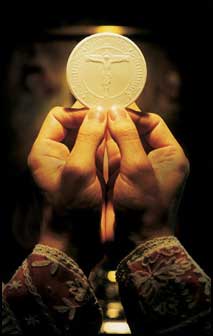
In the Eucharist, we receive not just a new, fleshy heart in place of our stony heart, but the very heart of the Living God! That is, we receive God’s very Self, the Son of God, the God Who Is Love. And not just so we can have some physical (or spiritual ?) proximity to Him. But as a vehicle for sharing in a new spirit, God’s very Spirit by which He, and through Him, we have a new kind of life. As Jesus says in the middle of His Bread of Life discourse:
Just as the living Father sent me and I have life because of the Father, so also the one who feeds on me will have life because of me.
John 6:57
Indeed, the Life of God which Jesus shows us is a life of love, or service.
Jesus gives another image of His life sustaining us, and our participation in His life, in the parable of the True Vine and branches:
I am the true vine, and my Father is the vine grower. … Remain in me, as I remain in you. Just as a branch cannot bear fruit on its own unless it remains on the vine, so neither can you unless you remain in me. I am the vine, you are the branches. Whoever remains in me and I in him will bear much fruit, because without me you can do nothing. … As the Father loves me, so I also love you. Remain in my love. If you keep my commandments, you will remain in my love, just as I have kept my Father’s commandments and remain in his love.
John 15:1, 4-5, 9-10

So, maybe more than in viewing the Eucharist as a living organ donation, it is in viewing Christ’s Precious Blood as a living blood transfusion that we can see more clearly how the Eucharist fosters our participation in God’s very life, our reception of sanctifying grace, God’s gift that makes us holy with His holiness.
I think Catholics can often overlook the need we have for sanctifying grace and how we become sharer is God’s divine life. In the mystery of the Incarnation, God manifested His intrinsic nature in His Son becoming one of us in Jesus. And as the Son of God shares in our human nature in Jesus, so through Him, Christians share in His divine nature, first in baptism, further in the sacraments – especially the Eucharist – but with the ultimate goal as saints in Heaven.
God has bestowed on us the precious and very great promises, so that through them you may come to share in the divine nature, after escaping from the corruption that is in the world. (Emphasis added)
2 Peter 1:4

Indeed, we are brought to share in God’s divine nature precisely through the Son of God manifesting God’s love and redeeming humanity on the cross, and our living that love in faith. As Jesus says,
Love your enemies, and pray for those who persecute you, that you may be children of your heavenly Father. . .. So be perfect just as your heavenly Father is perfect.
Matthew 5:44-45,48
This is how we become adopted children of God and co-heirs of heaven with Jesus, the Only Begotten Son of God.
Beloved, let us love one another, because love is of God; everyone who loves is begotten by God and knows God. Whoever is without love does not know God, for God is love. In this way the love of God was revealed to us: God sent his only Son into the world so that we might have life through him. In this is love: not that we have loved God, but that he loved us and sent his Son as expiation for our sins. Beloved, if God so loved us, we also must love one another. No one has ever seen God. Yet, if we love one another, God remains in us, and his love is brought to perfection in us.
1 John 4:7-12. Cf. Romans 8:14-17.

This is one of the meanings and purposes of the Eucharist: to share in and strengthen in us the love of the Father by sharing in the life of the Son. This is just one of many interrelated facets to the Mass and the Eucharist: the perfect prayer of praise Jesus offers His Father in His obedient sacrifice on the cross, the memorial and fulfillment of the Old Covenant of Passover and the memorial and re-presentation of the New Covenant of the Last Supper/Calvary, a sacred meal by which we enter into communion with God and neighbor, Jesus abiding presence (His Real Presence) with us until the end of the age.
As I’ve noted in past celebrations of Corpus Christi, Saint Thomas Aquinas (along with myself) had a particular devotion to the Most Holy Sacrament of the altar, and that he is credited with composing the Divine Office (Liturgy of the Hours) with proper hymns and readings for the celebration of the feast. In the Summa Theologiae especially, he marvels that Jesus should give His very Self in the Eucharist at Mass under the appearance of bread and wine. Though he didn’t coin the term “transubstantiation,” Saint Thomas articulates with remarkable precision and clarity what must be true given what Jesus said at the Last Supper:
While they were eating, Jesus took bread, said the blessing, broke it, and giving it to his disciples said, “Take and eat; this is my body.” Then he took a cup, gave thanks, and gave it to them, saying, “Drink from it, all of you, for this is my blood of the covenant, which will be shed on behalf of many for the forgiveness of sins.
Matthew 26:26-28. Cf. 1 Cor 11:24
and in the Gospel of John,
I am the bread of life. … this is the bread that comes down from heaven so that one may eat it and not die. I am the living bread that came down from heaven; whoever eats this bread will live forever; and the bread that I will give is my flesh for the life of the world. … Amen, amen, I say to you, unless you eat the flesh of the Son of Man and drink his blood, you do not have life within you. Whoever eats my flesh and drinks my blood has eternal life, and I will raise him on the last day. For my flesh is true food, and my blood is true drink. Whoever eats my flesh and drinks my blood remains in me and I in him.
John 6:48, 50-51,53-56
And given that Saint Paul declares that one should look on the bread of communion and discern the body of Jesus. (1 Cor 11:29)
With regard to Mass and the Eucharist, the Church rightly emphasizes the doctrine of the Real Presence: that under the species or appearance of bread and wine, Jesus is really, truly, substantially, and sacramentally present in the Eucharist in his resurrected person: body, blood, soul and divinity. Given that recent surveys seem to indicate that a significant number of Catholics don’t fully appreciate this doctrine, there has been a renewed emphasis on it through preaching and practices like Eucharistic Adoration and processions, and the aforementioned National Eucharistic Congress. This is all to the good and to be commended and encouraged. When I was a teenager and young man in the 1980’s, the Church emphasized the communion between the faithful and God and with each other, but did so to the neglect, and sometimes outright discouragement, of such practices and devotions. As one with a particular devotion to Jesus present in the Blessed Sacrament, I welcome the renewed attention to Christ’s Real Presence. I think that, in conjunction with it, we can also give greater attention to the life-giving aspect of Christ’s presence among us, as well. It can also help dispel misconceptions about the Holy Eucharist.
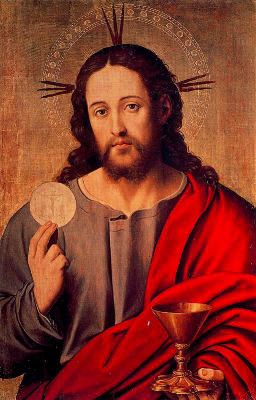
From the earliest centuries of the Church, pagans have leveled against Christians horrified accusations of practicing cannibalism in our sacred meal, and even today Catholics continue to be mocked for our Eucharistic beliefs. While of course false, these criticisms do attest to the early and continuous belief of Catholics that the Eucharist is truly the body and blood of Christ. Jesus’ declaration “I am the living bread” is enough to dispel this libelous charge, for cannibals only eat dead meat. To emphasize, however, the living character of the Blessed Sacrament, viewing it as the donation of a living organ or a live blood transfusion can go further to freeing people, especially the Catholic faithful, from being distracted or confused by so grotesque a caricature.
There have been many images suggested over the centuries to illustrate Jesus’ Eucharistic presence. Perhaps the strangest is the Pelican.

The symbolism of the mother pelican feeding her little baby pelicans is rooted in an ancient legend which preceded Christianity. The legend was that in time of famine, the mother pelican wounded herself, striking her breast with the beak to feed her young with her blood to prevent starvation. Another version of the legend was that the mother fed her dying young with her blood to revive them from death, but in turn lost her own life.
Given this tradition, one can easily see why the early Christians adapted it to symbolize our Lord, Jesus Christ. The pelican symbolizes Jesus our Redeemer who gave His life for our redemption and the atonement He made through His passion and death. We were dead to sin and have found new life through the Blood of Christ. Moreover, Jesus continues to feed us with His body and blood in the holy Eucharist. …
In the hymn “Adoro te devote,” the sixth verse (written by St. Thomas Aquinas and translated into English by Gerard Manley Hopkins) reads,
Like what tender tales tell of the Pelican
Catholic Education Resource Center
Bathe me, Jesus Lord, in what Thy Bosom ran
Blood that but one drop of has the powr to win
All the world forgiveness of its world of sin.
I am sure I am not the first to connect organ donation with the Eucharist, but it had not been suggested to me until I saw the church marquee sign I mentioned above. I hope, though, that this image of Jesus as Living Organ Donor and His Precious Blood given us in a Divine Transfusion may help to convey something worthwhile to contemplate on the Solemnity of the Body and Blood of Christ.
 Thomistic Philosophy Page