I was not going to repost or promote my reflections on the origin of Halloween from 2021 as I did last year. I figured I had done what I could to set the record straight, and get the word out. Alas, this article from a generally trustworthy source continues to give the impression that the Christian All Saints Day and anticipatory Halloween are somehow connected to the pagan Celtic celebration of Samhain.
As the reach of Christianity spread throughout the Celtic territories throughout the 9th century, All Saint’s Day blended into the traditions of the Celtics.
St. Patrick, et al., of course, had evangelized “Celtic Territories” (Ireland, et al.), in the 5th century AD. This Magis Center article, sadly, links to a poorly researched and inaccurate one from the History Channel that perpetuates the myth that the Church created All Saints Day and Halloween to supplant or coopt pagan practices.

Christian Samhain
As Christianity gained a foothold in pagan communities, church leaders attempted to reframe Samhain as a Christian celebration.
The first attempt was by Pope Boniface in the 5th century. He moved the celebration to May 13 and specified it as a day celebrating saints and martyrs. The fire festivals of October and November, however, did not end with this decree.
In the 9th century, Pope Gregory moved the celebration back to the time of the fire festivals, but declared it All Saints’ Day, on November 1. All Souls’ Day would follow on November 2.
Read my post below to get the fuller story, but Celtic territories in Europe had been Romanized since the first century AD, and become Christian by 5th century. Samhain had ceased to be as a (minor) pagan feast long before All Saint’s Day had reached the Emerald Isle in the 9th. Pope Boniface IV (d. 615) did not move Samhain in the 5th century, but in the 7th century instituted a feast for Mary and All Martyrs on the occasion of the Eastern Roman Emperor giving the Christians in Rome the Pantheon, with Boniface dedicating it as a church. I would be astounded if there was evidence Boniface was even aware that inhabitants of the backwater Ireland had celebrated the minor pagan fall festival 600 years earlier.
Some may wonder, would it be so bad if the Church had Christianized the pagan feast of Samhain? I guess that depends on one’s attitude on the relation of Christian evangelization to the pagan cultures it seeks to evangelize. To modern sensibilities, such a supplanting or coopting of pagan culture is an act of cultural imperialism and suppression of native, indigenous peoples. (Obviously bad.) According to traditional Christian sensibilities, it is a matter of inculturation, taking what is good in non-Christian cultures and incorporating what is not opposed to it into the Gospel message to make the latter more easily understood by indigenous peoples in their native language. (Obviously, to these Christians anyway, good.) Whether inculturation is damnable or laudable in general, however, in this case of Halloween and Samhain, neither applies since the truth is that Halloween had nothing to do with Samhain. And truth matters. So please to enjoy:
Is Halloween a Pagan Festival?
It is a question that still arises in Catholic circles and among other Christians more generally, so I thought I would repost the answer as I had done on other venues in years past.

The Short answer is No. Halloween is a thoroughly Christian and Catholic celebration whose date was set as an accident of history and has nothing whatever to do with ancient, Celtic pagans. It is the evening pre-celebration, or Evening Vigil, of All Saints Day – All Hallows Evening became Hallows E’en which became Halloween. And the All Saints’ Day celebration in the Christian Church in honor of all the holy men and women (and angels) in heaven started in Rome in 609 AD, when the Roman Pantheon temple was re-dedicated by Pope Boniface IV to all saints Mary and All Martyrs and the feast day was celebrated on May 13.
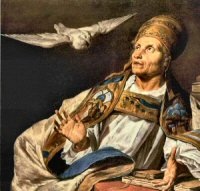
Pope Gregory III (who died in 741 AD) moved the Feast of All Saints or “All Hallows” to November 1 when he dedicated All Saints Chapel in St. Peter’s Basilica in Rome in the 8th century. In the 9th century, Pope Gregory IV decreed that All Saints Day should be observed everywhere and eventually the feast day came to Ireland which had been Christian for over 400 years.
No pagan celebration had anything to do with the Catholic Church instituting the celebration of All Saints’ Day on November 1st.
“But didn’t the Church take over a pagan, Celtic holiday?” you may ask. Again, No.

Ancient Celts of Ireland and Britain did celebrate a minor festival called Samhain (pronounced SOW-in) on October 31 for the end of harvest. But they also had a festival on the last day of most other months of the year. There was no ‘god of the dead’ by this name. Celts/Druids in Gaul and Britain, however, were persecuted and absorbed by the pagan (not Christian) Roman Empire in the 1st century AD.

It wasn’t until 300 years later that St. Patrick (and others) converted Ireland to Christianity from Roman/Celtic paganism, starting in 431 AD. But Samhain was not a thing for those pagans by that time, and the Christians would not celebrate All Saints’ Day (starting in Rome) for another 200 years. Samhain had nothing to do with the Catholic Church instituting the celebration of All Saints’ Day on November 1st, which it did, as we said, in 8th century – over 700 years after Samhain was forgotten by the Celts whom the Romans destroyed.
What about All Souls’ Day?

In 998 AD, St. Odilo, the abbot of the powerful monastery of Cluny in Southern France, added All Souls Day, a day of prayer for the souls of all the faithful departed (in purgatory) to the calendar for his monastery on November 2nd. Eventually this spread from France to the rest of Europe.
So, when did Halloween get spooky?
Sometime after the 10th century, Irish Catholic peasants apparently began to wonder, if the Church had feasts for all those in heaven and all those in purgatory, “What about those in hell?“ They seem to have thought that if the living didn’t remember the souls in hell, they might get upset and cause trouble. So, it seems it became customary in Ireland to bang pots and pans on All Hallows E’en to let the damned know they were not forgotten. (And maybe to scare them away?) Even for these Catholics in Ireland, they knew nothing about pagan Celts and Samhain, as it had been blotted out by Roman brutality 900 years prior!
To sum up:
- Samhain (a minor Celtic feast on October 31st) ceased being celebrated anywhere in Europe because of suppression by pagan Romans in the 1st century.
- Ireland became Christian in the 5th century.
- All Saints’ Day (on May 13) was instituted in Rome in 609 AD with the rededication of the pagan Pantheon temple as a Christian Church (which it still is today).
- In Rome, All Saints’ Day moved to November 1st in the 8th century, but All Saints Eve (October 31) did not have any special significance.
- All Souls Day on November 2nd was added in the 10th century to pray for souls in purgatory.
- In the 11th century, the Catholic Irish invented the custom of banging pots to remember the damned on October 31st (but not wearing costumes) completely unaware of Celtic Samhain.
It was not until the 16th century or later in Protestant England that people tied the ancient pagan Celtic celebration of Samhain to the Catholic Feast of All Saints’ Day and All Souls’ Day (as part of the general anti-Catholic Black Legend in England).

Costumes and trick-or-treating came about separately, but these also have Catholic origins. If you would like to know more, here is a link to an article on the Catholic origins of Halloween.
So, if you were wondering, or if someone asks, the Catholic Feast of All Saints has nothing to do with any pagan Celtic festival.
 Thomistic Philosophy Page