Today is the Feast Day of Fra Angelico/Blessed John of Fiesole, one of my favorite Dominican saints/blesseds.(See my post for his feast day from 2022 on why, and for samples of his frescos.)
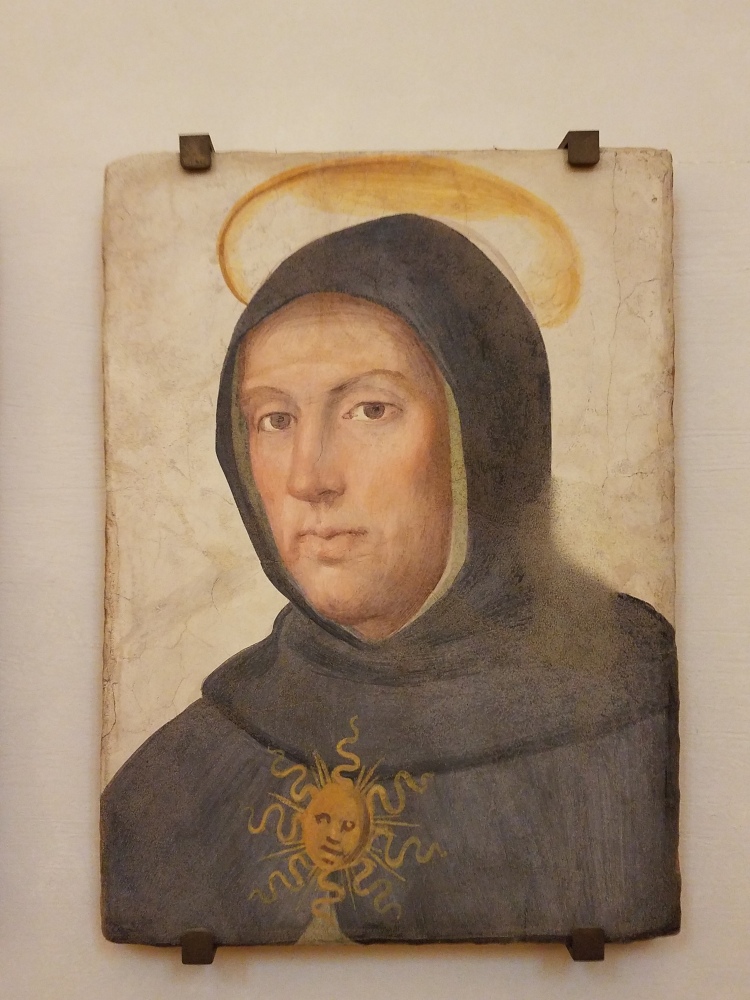
The artist apparently had a devotion to his confrere, Saint Thomas Aquinas, as an early work of his is a portrait of the Angelic Doctor (left), and he placed the him in many of his groups of saints attending scenes from the Gospels. Importantly for his art, Fra Angelico also shares with Saint Thomas an appreciation of the metaphysical principles of matter and form inherited and assimilated from Aristotle
Art historians credit Fra Angelico with advancing the realism and naturalism of renaissance painting, especially the grouping of figures in realistic, natural poses.
In 1439 Fra Angelico completed one of his most famous works, the San Marco Altarpiece at Florence. It broke new ground. Not unusual had been images of the enthroned Madonna and Child surrounded by saints, the custom was that the setting looked heaven-like, saints and angels hovering as ethereal presences rather than earthly substance. But in the San Marco Altarpiece, the saints stand squarely within the space, grouped in a natural way as if conversing about their shared witness of the Virgin in glory. This fresh genre, Sacred Conversations, was to underlie major commissions of Giovanni Bellini, Perugino and Raphael.
A strong case can be made that this artistic realism and naturalism owes its development in Western art, especially in the sculpture of Gothic cathedrals and the transition from Romanesque and Byzantine-like paintings of the early renaissance, to the re-introduction of the works of Aristotle and the theory hylomorphism to the Western Europe in the 12th and 13th Centuries for it afforded artists, as well as philosophers and theologians, the intellectual resources to assert the fundamental and essential unity the human person, and material things as embodying, not just symbolizing or representing in a stylized manner, transcendent beauty, meaning, and values. According to Aristotle, the material things of the sensible universe are composites of both matter and form. Form is the principle of determination which accounts for the thing being the kind of thing it is, while matter is the principle of potentiality, of the ability to become other than it is. Taking an example from the world of artifacts, the shape of a statue is its form, while the material of which it is the shape, marble for instance, is the matter. Neither matter nor form are things in themselves, that is, they are not complete substances. Thus, neither exists without the other, but both are principles which explain the existence of particular material realities. Matter cannot exist without some substantial form; substantial form is not instantiated except in some material substrate.
Christopher Cullen, Professor of Medieval Philosophy at Fordham University, has argued convincingly that scholastic incorporation and development of the hylomorphism of Aristotle, accounts for the fact that it was only at this time that medieval artists returned to classical models which had persisted among the Roman ruins in order to imbue their art with a new found naturalism and realism.[1] The transition of sculpture and painting from the characteristically stylized and intellectualistic form of the Romanesque style (above) to a more natural, realistic style roughly corresponds to the period of the re-discovery of Aristotle and the adoption of hylomorphism, thereby anticipating and facilitating the Italian Renaissance that would follow.
One can see the influence of scholastic hylomorphism in the fresco paintings of the early Renaissance master, Giotto. Nearly all art historians recognize the extraordinary difference between Giotto’s painting, with its realistic portrayals of the human being, and what went before. It is striking. Giotto moved away from the two-dimensional paintings in which the figures are set against a background of solid gold to amazingly naturalistic paintings in which human beings come alive in a three-dimensional world literally filled with drama and narrative. (50)
Giotto, Pieta or Lamentation in the Arena Chapel, Padua (1305-06)
There were many factors that influenced Giotto and that gave rise to the changes in his style. Without minimizing the role of these influences, it is important to recognize the philosophical source that makes the changes possible. It is found in a different understanding of the human being and of the relation between soul and body. In scholasticism’s doctrine the body exists in such a unity with the soul that the body can express the highest aspirations and deepest religious beliefs of the soul.
Giotto’s connection with this Aristotelianism is difficult to establish. But I think it can be found in that he turned to sculpture as a model for his painting. Sculpture was ahead of painting in his time, and so, he looked to the best sculpture of his day for the model of the human form in his paintings-he looked to Nicola Pisano (c. 1210/1220-c. 1278/1284).
Nicola is generally regarded as the most important thirteenth-century sculptor, along with his son Giovanni (c. 1245-1304). He introduced a new classicism and thus a new realism into sculpture. Now what is significant for this thesis is that Nicola was trained at the court of Frederick II, the Holy Roman Emperor. The court of Frederick II in Palermo was a center of Aristotelianism; indeed, remember that it was at the University of Naples, which Frederick II founded in 1224 to train men for imperial service, that Aquinas himself was first exposed to Aristotle by Peter of Ireland, who was “part of an Aristotelian movement generally associated with the court of Frederick II.” Torrell says in his biography of Aquinas, “Aristotelian science, Arabic astronomy, and Greek medicine all were flourishing in Palermo, Salerno, and Naples.” It was in Naples, for example, that Michael Scot, who entered the emperor’s service in 1220, was busy making translations of parts of Aristotle, as well as Arabic and Greek sources. Nicola was. in part, influenced by this Aristotelianism at the court of Frederick II. (51-2)
The Aristotelian-Scholastic metaphysical doctrine, when combined with the Renaissance’s return to classicism, made it possible for sculpture and painting to reach new heights. Much is usually made of the influence of classical humanism on the Renaissance artists. . . . Classical naturalism is no doubt an important influence, but perhaps, it is not the whole story. After all, the examples of naturalism from classical antiquity had been around quite some time without being imitated, especially in areas where there were extensive Roman ruins, such as the Italian peninsula. (52)
Certainly, Fra Angelico was likewise imbued with Aristotelian-Thomistic hylomorphic sensibilities, and these are clearly embodied in his artistic naturalism.
I earned my PhD in 1999 and published my dissertation in 2003. I invented the Variably Expanding Chain Transmission (VECTr) which was patented in 2019 (US 10,167,055).
View more posts
One thought on “Happy Feast of Fra Angelico/Blessed John of Fiesole, OP – 2025”


 Thomistic Philosophy Page
One thought on “Happy Feast of Fra Angelico/Blessed John of Fiesole, OP – 2025”